Node.js: The Paradigm Shift of JavaScript
How a Browser Script Conquered the Server-Side World

For nearly fifteen years, JavaScript was a language with a very specific, limited "home". It lived inside web browsers, performing simple tasks like validating forms or creating flashy animations. If you wanted to build a real application backend, you had to learn a "serious" server-side language like PHP, Java, or Ruby.
Then came 2009, and the walls of the browser came down. Node.js arrived, and suddenly, JavaScript wasn't just for the frontend anymore. It became a powerhouse for the modern, scalable web.
1. What is Node.js? (Runtime vs Language)
One of the most common mistakes beginners make is calling Node.js a "programming language" or a "framework".
The Language: JavaScript is the set of rules, syntax, and logic you write.
The Runtime: Node.js is the environment that allows that language to execute.
Think of it like this: JavaScript is the "car", and for a long time, the only "road" it could drive on was the Web Browser. Node.js built a new, high-speed highway that allows the same car to drive on the Server. It is an open-source, cross-platform runtime environment that liberated JavaScript from its browser-only origins.
2. Why was JavaScript Originally "Browser-Only"?
In 1995, Brendan Eich created JavaScript in just ten days for Netscape Communications. At that time, the internet was a collection of static, boring pages. JavaScript was designed specifically to interact with the DOM (Document Object Model) - the structure of a webpage.
Because it was designed to run on a user's machine (client-side), it was locked inside the browser for security and functional reasons. It didn't have the "keys" to the computer's filing system or network ports - standard features for server-side languages. It stayed in that "sandbox" until Ryan Dahl combined a high-performance engine with a revolutionary architectural idea in 2009.
3. How Node.js Made the Jump to Servers
The transformation didn't happen by magic. Node.js was built by combining three high-performance components into a single architecture.
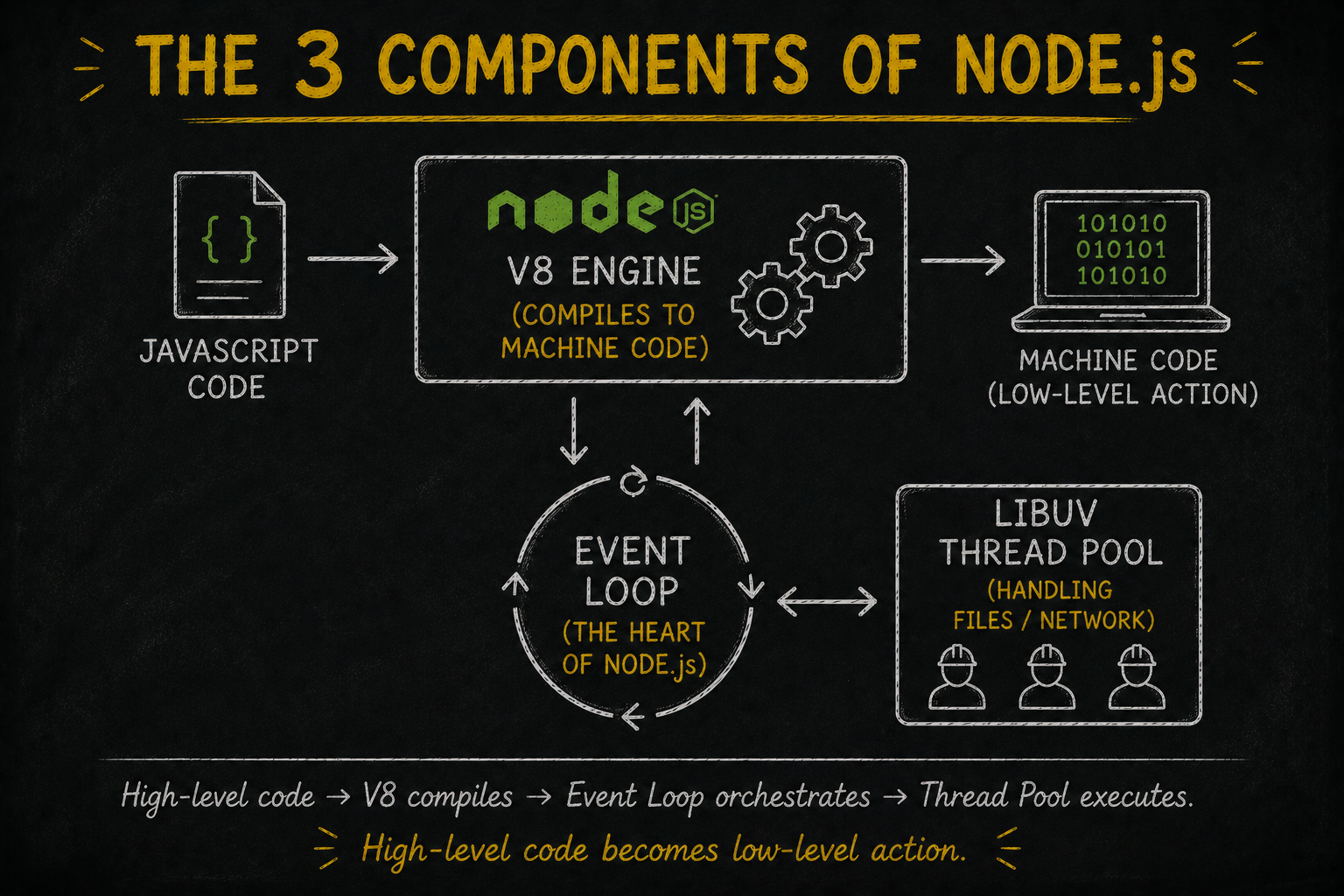
The Three Pillars of Node.js:
Google’s V8 Engine: This is the same engine that makes Google Chrome fast. It takes JavaScript code and compiles it directly into machine code (the language computers speak) instead of interpreting it line-by-line.
Libuv: A C++ library that handles the "dirty work" of the operating system, like accessing files, memory, and networking.
The Event Loop: The "waiter" of the system. It manages tasks and ensures that the single thread stays busy without ever getting stuck waiting for a task to finish.
4. The V8 Engine: The High-Speed Heart
At a high level, the V8 engine is a performance beast. It uses Just-In-Time (JIT) compilation.
Instead of translating your code every time it runs, V8 observes your code as it executes. If it sees a specific function being used frequently (a "hot" function), it optimizes it into highly efficient machine code. This makes Node.js significantly faster than traditional interpreted languages like PHP.
5. The Event-Driven Architecture Idea
Most traditional servers (like Java or PHP) are Multi-threaded. When a user makes a request, the server spawns a new "thread" (a worker). If 1,000 users arrive, you need 1,000 workers. If they all ask to download a large file, those 1,000 workers sit there doing nothing while the file transfers. This is Blocking I/O.
Node.js is Single-threaded and Event-driven. It doesn't spawn new workers. Instead, it acts like a single, high-speed waiter in a cafe.
A customer orders (an event occurs).
The waiter hands the order to the kitchen (I/O task).
Instead of waiting at the kitchen, the waiter immediately takes the next order.
When the food is ready, the waiter is notified and serves it between other tasks.
This Non-blocking model is why Node.js can handle tens of thousands of concurrent connections with very little memory.
6. Real World Use Cases: Who uses Node.js?
Because Node.js is great at handling many small, fast connections, it has been adopted by the world's largest companies:
Uber: Uses it for real-time ride-matching and tracking.
Netflix: Reduced its startup time by 70% by moving its interface orchestration to Node.js.
PayPal: Doubled their requests per second after migrating from Java to Node.js.
Walmart: Famously handled its massive Black Friday traffic with zero downtime using Node.js.
Conclusion: Why Developers Love Node.js
The biggest reason for Node.js's success isn't just speed , it's Universal JavaScript. Developers can now use the same language, the same logic, and often the same libraries for both the frontend and the backend. This "Full Stack" capability reduces the friction of building modern apps and has created the largest ecosystem of reusable code (NPM) in the world.


